
Building out a fleet management system
Nearly every company that runs a service has a fleet of vehicles or machinery at the helm of their operations.
SafetyCulture is a workplace operations app, best known for its inspection and task management features. It's loved by customers like Piccolina Gelateria who use it to handle icecream deliveries with their fleet of trucks, and Virgin Voyages, who ensure that their line of cruise ships are safe to set sail.
SafetyCulture
Product Designer
Aug 2023 to Jan 2024
Web app + mobile + IoT
2 Designers
12 Engineers
2 PMs
The opportunity
The success of SafetyCulture had largely been due to the flexibility of our platform being suitable for businesses across different industries. Our product was broad, but not deep. As our growth expanded, our business wanted to go deeper into verticals in order to capture more enterprise customers. During my time at SafetyCulture, we noticed many use cases in the fleet management sector popping up. While our product enabled our customers to conduct regular inspections and initiate actions against their fleet, there were key functionalities missing to effectively track, maintain, and forecast work with their fleet in SafetyCulture.
The solution
We formed a new team by merging two existing teams at SafetyCulture: the Assets team and the Sensors & IoT team. With the combined expertise and resources of these teams, we began researching and building a roadmap of features to facilitate preventative maintenance, utilisation reporting, and a workflow builder that pulls together features across our entire platform.
Some key challenges
As we moved towards providing deep solutions for verticals, how do we ensure a balance between a prescriptive versus a flexible offering?
Our teams were quite siloed and features weren't always working with each other. How could we contribute to pulling parts of the product together in a seamless way while making sure that the things we build didn't contribute to more "design debt"?
In a similar vein, many other teams were thinking about similar features. How could we all work together instead of duplicating, often inflexible, work?
The scope of the work was large, so we ran the risk of building lots of features that don't go deep enough to meaningfully solve our customers' problems.
The discovery process

Evaluation our starting point
Visualising the insights
Defining the problem
Crafting the solutions
Evaluating our starting point
I'm determined to begin a project by understanding how we got to where we are (our current state), but also learning from adjacent and past projects, features and research. I believe that our past knowledge can help us get to future solutions faster while helping us stay cognisant of repeating old mistakes.
To begin, we gathered everything we already knew about this space:
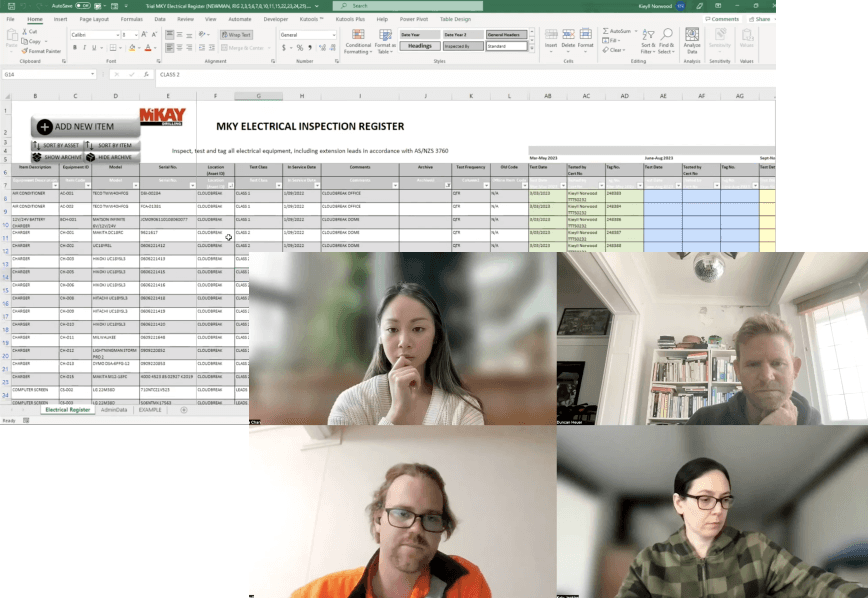
We had just released a few product experiments as part of an initial telematics project. These included automated data capture of Odometer and Run time readings from third party integrations and a map view showing the live GPS location of vehicles. We had a small pool of customers to get direct feedback from.
We had began integrating with a number of third party asset management systems so that users can bring in their assets into our platform. We wanted to understand why our customers integrated with those apps and how their ecosystem of work works.
Existing UX patterns in the platform that could support a fleet management solution.
A library of customer interviews and feedback from early adopters of our Assets feature.
And, of course we had some cold, hard numbers to go off of.


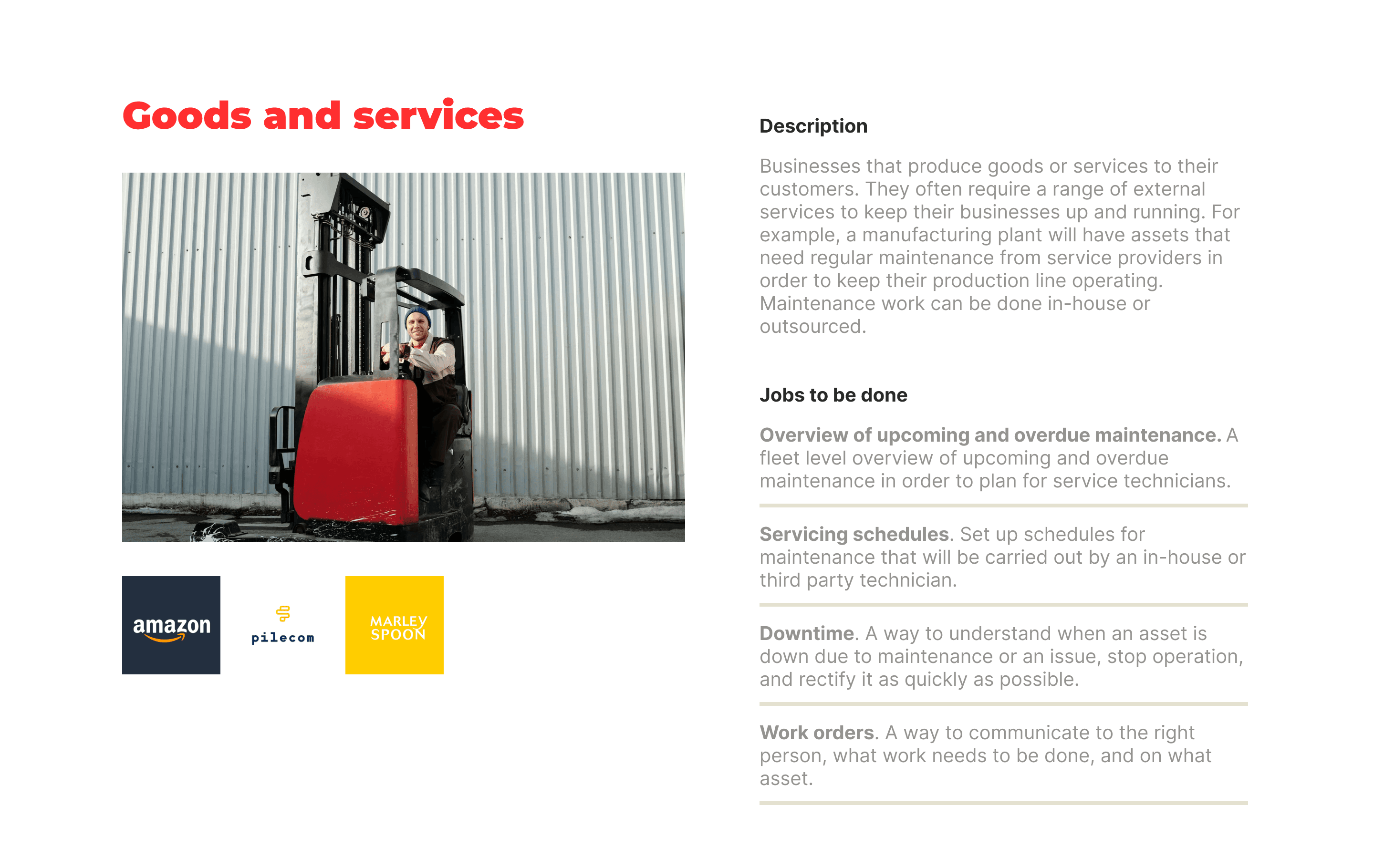


Why functional personas?
As an organisation, we had tried to do a good job of understanding personas based on user behaviour segmentation, I found that these were more useful for onboarding new users or when we were building out features for different archetypes, such as your administrator versus your end-user.
For this project, the crucial piece missing is our understanding of the types of businesses we serve and the type of work they needed to do.
Building for different kinds of business needs
When we build solutions, in the past we got into the trap for building for one kind of business model. This resulted in parts of our product working super well for those customers, but barely functional for others. When speaking to customers we heard so much conflicting feedback that we realised that our solution must be flexible enough for multiple types of business functions.


Defining the problem and outcome
At the beginning of 2024, we got together as a team to facilitate a workshop to generate a roadmap for a fleet management packaged solution. Together with the insights generated from our customer research and my journey map, myself and our triad leadership team ran a workshop to define the key problem we were solving and where we wanted to be.

Using the lean UX canvas
Together as a team will used the Lean UX Canvas to build out a quick plan. It helps I found that a UX canvas helps our team get on the same page about what really matters: the user’s needs and the project's outcomes. It breaks down the process into clear steps, making it easier to move quickly, test ideas, and adjust based on learnings. I like using a modified canvas that focuses on a few key steps to keep things simple:
The current state business and customer problem
The ideal business and customer outcome; and
How we get from the current state to the ideal outcome
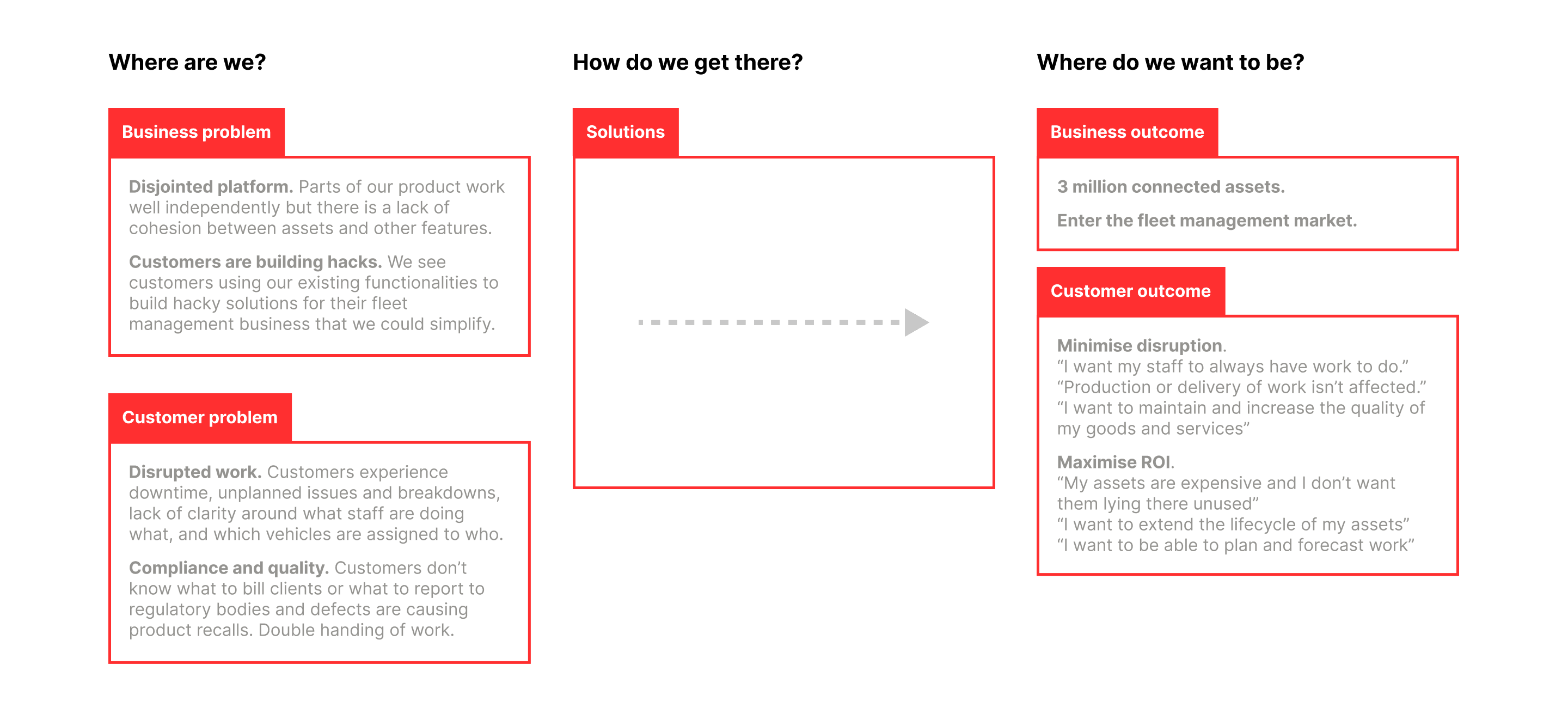
Once we had clarity around what the problem was and where we wanted to go, we could now start to build out our roadmap of solutions.
Communicating the solution
As a team, we all wrote down the features we would need to build in order to satisfy our business and customer outcomes. Then I put together some mixed-fidelity wireframes within the framework of a customer journey. These designs were intended as communication tools — to make sure that we were speaking the same language within our own team, and to illustrate the vision when we were speaking to external teams and stakeholders. They serve to communicate a concept, not to brief delivery.


What's next
Well, now we execute on the plan :) The vision was unfortunately years away in reality, so we needed to prioritise what we would build. We knew that certain pieces of the vision were foundational — they must be built first in order to 'unlock' an important part of the workflow. That's why we made the decision to begin delivering the first iteration of this project: meter readings. Collecting meter readings from inspections meant that we could then support triggering activities off specific data points. You can read more about the delivery in my other case study on meter readings.

