
Designing complex data workflows
SafetyCulture has long been recognised for our strength in capturing data from the frontline. Our customers are not your typical office worker. Instead, they are the hard-hat wearers out on a construction site, the workers down in the mines, and the people operating the transportation that powers our world.
Like many start-ups that have grown up, our business strategy started to shift towards catering for the enterprise. Sales meetings turned from casual chats with a mid level supervisor, to month long deals with CIO types. We kept running into the same problem when it came to getting these deals across the line: SafetyCulture just did not connect with their wider ecosystem.
Our product worked great on it’s own, but the reality was that our customers (especially the big ones) would never use SafetyCulture in isolation. Customers wanted us to work with their ERP systems like SAP, their customer database in Salesforce or to generate SafetyCulture tasks automatically from heavyweight systems like ServiceNow.
Company
Company
SafetyCulture
My role
My role
Senior Product Designer
Timeline
Timeline
Apr to Dec 2025
Platform
Platform
Web app + mobile
The team
The team
1 Designer
1 PM
3 internal eng teams
My role
So where did I fit in? Together with my API & Integrations team, I led this project as a Product Designer. My main focus was on customer research - getting to the bottom of how our customers' ecosystems actually looked like. And then translating these insights into a strategy for the platform. In the end these are the three things I cared about getting across the line the most.
Bringing customer pain points to the forefront and stressing just how much these broken data flows impacted our customers' day to day workflows. If our team collectively understood the extent of the problem, everyone is more likely to get around it to solve these problems together. Strength in numbers.
Clearly articulating changes that we could make in the product tomorrow to help our product scale for enterprises. I want these changes to be a series of small experiences that were easy to digest (and build) that would compound into large impact.
Encouraging other product and design teams to build with integration in mind, guided by clear principles that make connecting products simple and consistent.
As Product Designers, I believe that our jobs really go beyond understanding our customers' problems. Don't get me wrong, customer is still the beating heart of product design. But so much of the real work happens in the storytelling and the “glue-ing” of teams together so that we can move forward and shape a shared future together.
Results
This work was driven by a belief that SafetyCulture shouldn't try to do everything, but rather do what we’re great at: mobile first data capture. The rest could be “outsourced” to external systems. Since the project, we’ve already seen meaningful outcomes across product strategy, team collaboration, and customer value.

Start inspection
Yes
No
Yes
No
Report Issue


Replace headlights
To do


My role
So where did I fit in? Together with my API & Integrations team, I led this project as a Product Designer. My main focus was on customer research - getting to the bottom of how our customers' ecosystems actually looked like. And then translating these insights into a strategy for the platform. In the end these are the three things I cared about getting across the line the most.
Bringing customer pain points to the forefront and stressing just how much these broken data flows impacted our customers' day to day workflows. If our team collectively understood the extent of the problem, everyone is more likely to get around it to solve these problems together. Strength in numbers.
Clearly articulating changes that we could make in the product tomorrow to help our product scale for enterprises. I want these changes to be a series of small experiences that were easy to digest (and build) that would compound into large impact.
Encouraging other product and design teams to build with integration in mind, guided by clear principles that make connecting products simple and consistent.
As Product Designers, I believe that our jobs really go beyond understanding our customers' problems. Don't get me wrong, customer is still the beating heart of product design. But so much of the real work happens in the storytelling and the “glue-ing” of teams together so that we can move forward and shape a shared future together.
Results
This work was driven by a belief that SafetyCulture shouldn't try to do everything, but rather do what we’re great at: mobile first data capture. The rest could be “outsourced” to external systems. Since the project, we’ve already seen meaningful outcomes across product strategy, team collaboration, and customer value.
64%
Paid seat growth in enterprise orgs 12 months since strategy implemented.
2
Large scale features launched
off the back of the strategy across
3 feature teams
112%
Increase in ARR for orgs with integrations connected vs orgs without.
Going wide, honing in
To shape this strategy, I led a discovery effort focused on understanding the ecosystem needs of our enterprise customers.
Generally, in product design, it's normal to go straight to the source and talk to customers. But this time, I did something different.
I went into our archives and watched hours and hours of past interviews with our team conducted with past customers.
At the same time, I was also setting up sessions with our go-to-market reps, our customer success engineers, and taking my insights back to my engineering team to dig in a little bit deeper.
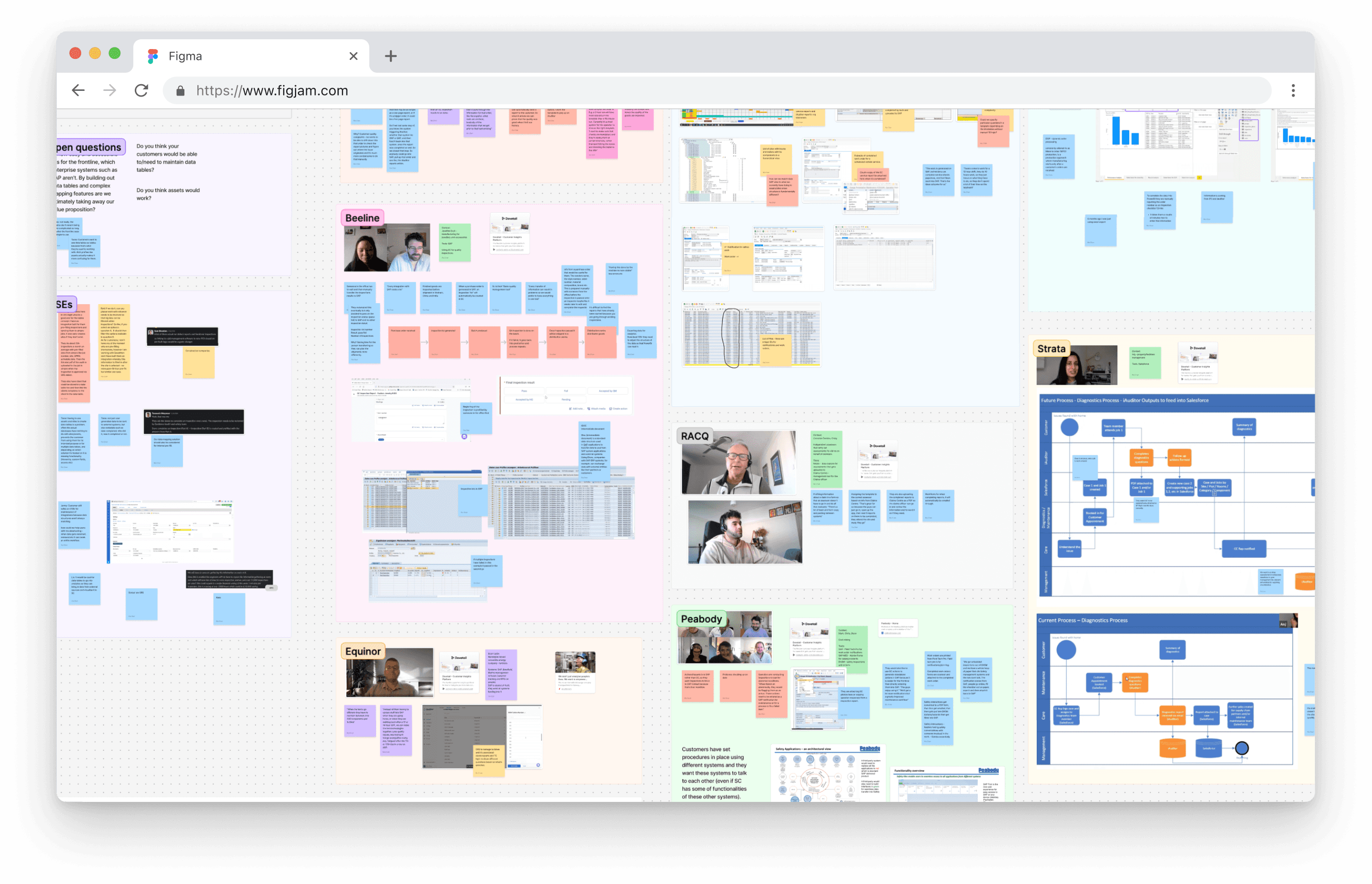
This is just a messy look at the notes and screenshots I took during these sessions to get my head around the emerging themes:
Insights are waiting to be found
I'm lucky enough to have been at SafetyCulture for a few years at this point, so I had a bit more knowledge of the domain and our customer use cases. But, it still never ceases to amaze me how often the customer problems stay the same even when years pass and new features are released after the fact. In fact, I found some of these old interviews contain less bias because they were never lead with the solution we have in mind today. Old interviews are truly the ground zero of user jobs-to-be done and pain points, where we can find gems like this:
“The guys are out on the fields for days in a row. Imagine it’s hour ten of your 12 hour shift and now you’re being asked to find the correct template and copy down a serial number made up of a jumble of letters and numbers into an inspection. Mistakes are bound to happen. If we can bring the serial numbers in automatically… even if we save five minutes per inspection, we could save $50,000 a year.”
Mark Eaglesham
Mining General Manager, Peabody Energy
Customer research report
Uncovering insights was only the first step. For this work to have real impact, I needed to help teams see the opportunities, adopt new ways of thinking, and start building toward a more connected platform. Here's a handful of artefacts I produced to drive this forward.
I created a research summary that laid out three key opportunity areas based on recurring customer pain points:
Simplify reporting: Make it easier for customers to extract and share insights from SafetyCulture.
Surface context: Bring external data into the product to reduce effort and increase accuracy.
Streamline workflows: Automate common tasks across systems to save time and reduce manual work.
This report was produced to be immediately useful for product teams. It highlighted integration needs tied to real use cases, and offered UX opportunities that teams could explore right away, or at least start thinking about embedding into their future work. Click below and take a read!
Integration design principles
To ensure teams had a consistent lens for thinking about integrations, I developed a set of principles focused on:
Connecting to external systems
Complementing existing business processes
Scaling with future complexity and data volume
Each principle came with reflection prompts to help designers and PMs think beyond “check-the-box” integration work, and instead embed integration logic deeply into product design.

Story mapping
To help others see the broader potential, I started building out a story map that highlights one of our customers Niftylift. Since this was such a data heavy project, sometimes talking about "connections" or "data-points" doesn't really get the point across. That's why I love story maps and storyboards. I can shift the narrative to a customer and walk my stakeholders through a single journey and help them reach that "ah-ha — I get it now" moment.
It's one of my favourite tools to highlight what's possible when we design for business processes, not features. Please have a click below to explore the storyboard in it's full glory!
Collaboration with product teams
As with many design artefacts, they often go on to die in a documentation graveyard somewhere. I didn’t want this work to live only in a document or a deck. So, in order to share these strategies in a practical way, my PM and I paired up with other teams to turn our insights into concrete product improvements. The nature of platform work is that the whole (working together) is greater than the sum of it’s parts and we wanted to lead by example.
Project 1: Data connected inspections
The first project aimed to solve use cases around Simplifying reporting and Surfacing context by prepopulating inspections with data from SafetyCulture and beyond. We worked with two other core teams at SafetyCulture to make this work a reality.
We used this project as a test case. By starting with one source of data (asset records) in one feature area of the product, we hoped that the outcome could be replicated and extensible across the platform.
Project 2: Integrate with HR systems
The first project aimed to solve use cases around Simplifying reporting and Surfacing context by prepopulating inspections with data from SafetyCulture and beyond. We worked with two other core teams at SafetyCulture to make this work a reality.
We used this project as a test case. By starting with one source of data (asset records) in one feature area of the product, we hoped that the outcome could be replicated and extensible across the platform.

Insights are waiting to be found
I'm lucky enough to have been at SafetyCulture for a few years at this point, so I had a bit more knowledge of the domain and our customer use cases. But, it still never ceases to amaze me how often the customer problems stay the same even when years pass and new features are released after the fact. In fact, I found some of these old interviews contain less bias because they were never lead with the solution we have in mind today. Old interviews are truly the ground zero of user jobs-to-be done and pain points, where we can find gems like this:
“The guys are out on the fields for days in a row. Imagine it’s hour ten of your 12 hour shift and now you’re being asked to find the correct template and copy down a serial number made up of a jumble of letters and numbers into an inspection. Mistakes are bound to happen. If we can bring the serial numbers in automatically… even if we save five minutes per inspection, we could save $50,000 a year.”
Mark E
Mining General Manager, Australian Mining Company
Customer research report
Uncovering insights was only the first step. For this work to have real impact, I needed to help teams see the opportunities, adopt new ways of thinking, and start building toward a more connected platform. Here's a handful of artefacts I produced to drive this forward.
I created a research summary that laid out three key opportunity areas based on recurring customer pain points:
Simplify reporting: Make it easier for customers to extract and share insights from SafetyCulture.
Surface context: Bring external data into the product to reduce effort and increase accuracy.
Streamline workflows: Automate common tasks across systems to save time and reduce manual work.
This report was produced to be immediately useful for product teams. It highlighted integration needs tied to real use cases, and offered UX opportunities that teams could explore right away, or at least start thinking about embedding into their future work. Click below and take a read!
Integration design principles
To ensure teams had a consistent lens for thinking about integrations, I developed a set of principles focused on:
Connecting to external systems
Complementing existing business processes
Scaling with future complexity and data volume
Each principle came with reflection prompts to help designers and PMs think beyond “check-the-box” integration work, and instead embed integration logic deeply into product design.
Story mapping
To help others see the broader potential, I started building out a story map that highlights one of our customers Niftylift. Since this was such a data heavy project, sometimes talking about "connections" or "data-points" doesn't really get the point across. That's why I love story maps and storyboards. I can shift the narrative to a customer and walk my stakeholders through a single journey and help them reach that "ah-ha — I get it now" moment.
It's one of my favourite tools to highlight what's possible when we design for business processes, not features. Please have a click below to explore the storyboard in it's full glory!
Collaboration with product teams
As with many design artefacts, they often go on to die in a documentation graveyard somewhere. I didn’t want this work to live only in a document or a deck. So, in order to share these strategies in a practical way, my PM and I paired up with other teams to turn our insights into concrete product improvements. The nature of platform work is that the whole (working together) is greater than the sum of it’s parts and we wanted to lead by example.
Project 1: Data connected inspections
The first project aimed to solve use cases around Simplifying reporting and Surfacing context by prepopulating inspections with data from SafetyCulture and beyond. We worked with two other core teams at SafetyCulture to make this work a reality.
We used this project as a test case. By starting with one source of data (asset records) in one feature area of the product, we hoped that the outcome could be replicated and extensible across the platform.
Project 2: Integrate with HR systems
The first project aimed to solve use cases around Simplifying reporting and Surfacing context by prepopulating inspections with data from SafetyCulture and beyond. We worked with two other core teams at SafetyCulture to make this work a reality.
We used this project as a test case. By starting with one source of data (asset records) in one feature area of the product, we hoped that the outcome could be replicated and extensible across the platform.
Quantifying the impact
All-in-all, a year after this research initiative we saw some huge changes in the SafetyCulture org.
Features released: teams released the first milestone of the HRIS and pre-fill feature with the guidance from this strategy.
A switch to an "API-first" focus: with AI and LLMs dominating the landscape, SafetyCulture eventually switched our product direction to focus on extending our public API capabilities. This research underpinned the product and design thinking in a very development heavy space.
Product metrics: as with all long term projects, benefits are often seen once we are long gone, but we saw some positive signs that we were heading in the right direction with the growth in ARR and seat counts for enterprise customers.

Let's work together
to build the future
Email me at reeyanna@gmail.com

Let's work together
to build the future
Email me at reeyanna@gmail.com
Quantifying the impact
All-in-all, a year after this research initiative we saw some huge changes in the SafetyCulture org.
Features released: teams released the first milestone of the HRIS and pre-fill feature with the guidance from this strategy.
A switch to an "API-first" focus: with AI and LLMs dominating the landscape, SafetyCulture eventually switched our product direction to focus on extending our public API capabilities. This research underpinned the product and design thinking in a very development heavy space.
Product metrics: as with all long term projects, benefits are often seen once we are long gone, but we saw some positive signs that we were heading in the right direction with the growth in ARR and seat counts for enterprise customers.